Showing posts with label kunci inggris. Show all posts

Saturday, 2 September 2017

DUA TIGA KNOWING FINLAND EDUCATION

DUA TIGA KNOWING FINLAND EDUCATION


 DUA TIGA KNOWING FINLAND EDUCATION

1. Children in Finland are not allowed to enter primary school if they are not yet 7 years of age. While in Indonesia, some schools allow children not even 7 years old - even 6 years - enter primary school. With the age of immature correct to get education in elementary school, children will be saturated and tend not optimal educational mengenyam.
2. Finnish teachers have other systems to assess students, not from exams and homework. This is at least done until they step on teenagers.
3. Unlike in Indonesia, in Finland, children are not measured from their first 6 years of education. In Indonesia, the first 6 years of schooling, that is, in elementary school, they have been assessed. Their value is considered to affect achievement.
4. There is only one mandatory standard test in Finland, when they are 16 years old. In Indonesia, 1st grade elementary school has been burdened with the final exam of the semester.
5. All children, smart or not, study in the same class. In Indonesia, there are acceleration classes, there are regular classes, there are also international classes. The class seemed to be a chasm.
6. 30 percent of children in Finland are awarded a 9-year scholarship for the school. In Indonesia, scholarships (formerly) are very difficult to obtain.

7. 66 percent of children in Finland are educated to college. In Indonesia many children drop out of school.
8. There is no gap that is too wide that distinguishes the brightest and most left behind students in the classroom. In Indonesia, the smart and who are considered left behind are very visible.
9. Science classes in Finland have a maximum of 16 students so they can practice and conduct research. In Indonesia, only certain schools have laboratories that meet the standards. It was used by many students.
10. 93 percent of Finns are high school graduates. In Indonesia, less than half the population enrolled in higher education.
11. 43 percent of Finnish high school students choose a vocational school. In Indonesia, vocational schools are marginalized.
10 Illustrations of Sweetness 'Sweet' New Couple Marry That Make Baper Aware Girls, It's 7 Signs Boys Just Love Your Paras Only
The beautiful series of Wedding Traditional Wedding Procession Raisa Sunda
12. Elementary students have 75 minutes of rest time a day. In America less than 30 minutes, while in Indonesia only 15 minutes.
13. Teachers spend only 4 hours in class. Meanwhile, 2 hours a week teachers get professional development education.
In Indonesia, teachers are 48 hours in class.

14. In Finland, the number of teachers and students is equal. Indonesia, especially in 3T areas, is short of teachers.
15. School fees are 100 percent funded by the state. In Indonesia, the budget for the Ministry of Education is cut.
16. All teachers in Finland must have master titles and are fully subsidized by the government. In Indonesia not all teachers graduate S1. If you want to pursue further education, most pay themselves.
17. The national curriculum is only a guide. The rest is flexible. The national curriculum in Indonesia is rigid and less flexible.
18. 10 percent of teachers are selected from 10 well-known and selected universities that are the best graduates in their universities.
19. In 2010, 6,600 people competed for 660 SD teacher training seats.
In Indonesia, elementary teachers are not considered prestigious jobs.
20. The average starting salary for teachers in Finland was 29 thousand US dollars in 2008.
In Indonesia, the average teacher salary does not meet the UMP or UMR.
21. In Finland, no salary is inappropriate for teachers. In Indonesia there are still teachers who receive a salary of 300 thousand rupiah a month.
22. Teachers are just as prestigious as doctors and lawyers. In Indonesia teachers are ignored.
23. In the calculation of international standards in 2001, Finnish children were interested in science, reading, and mathematics.


READ ALSO : BERBAHASA INGGRIS DENGAN BAIK

Wednesday, 9 August 2017

Profile or Biography of President Soekarno


 kunci

                             Profile or Biography of President Soekarno the Proclaimer. Probably until now he is the most widely admired person in Indonesia. Many people are looking for a short life journey, profile or biography of Sukarno. Known as the first President of the Republic of Indonesia as well as the originator of Pancasila, he is more familiar in call Bung Karno is from Blitar, he is a hero of the Proclamation along with Mohammad Hatta. President Soekarno was highly respected by the leaders of the countries of the world at that time. Soekarno was born in Surabaya precisely on June 6, 1901 with the original name named Koesno Sosrodihardjo, because often sick that may be caused by his name is not appropriate then he then changed the name to Soekarno.


The life of President Soekarno
His father was named Raden Soekemi Sosrodihardjo and a mother named Ida Ayu Nyoman Rai. His parents met in Bali when his father became a teacher in Bali and his mother was a nobleman in Bali. Soekarno is known to have a sibling or sister named Sukarmini.

Childhood and Young Sukarno

                   Regarding the life story of President Soekarno, as a child he did not live with his parents who are in Blitar. He lives with his grandfather named Raden Hardjokromo in Tulung Agung, East Java. Soekarno even went to school there although not to finish along with his parents moved to Mojokerto.In Mojokerto, Soekarno was then schooled at Eerste Inlandse School where his father also worked there as a teacher. However, he was transferred in 1911 to an ELS (Europeesche Lagere School) at the elementary school level to be admitted to HBS (Hogere Burger School) in Surabaya.
                After graduating and attending HBS in 1915, Sukarno then lived in Haji Oemar Said Tjokroaminoto or H.O.S Cokroaminoto house, which is a friend of Soekarno's father. Soekarno, Kartosuwiryo and Muso .H.O.S Cokroaminoto is known as the founder of the Islamic Union (SI). It was at Cokroaminoto's house that Soekarno became acquainted with Sarekat Islam (SI) leaders such as Haji Agus Salim and Abdul Muis. Soekarno is also familiar with Muso, Alimin, Darsono and Semaun who later became known as leftist and Kartosuwiryo who later founded Darul Islam and led the rebellion against Sukarno, although in the end Sukarno himself who signed the death sentence execution against Kartosuwiryo who became his friend when he was young .

               They together live in H.O.S Cokroaminoto's house to gain knowledge and learn to organize through Sarekat Islam (SI). Here the nationalist spirit of the nation of Indonesia becomes very big. Soekarno also took part in a youth organization in 1918 named Tri Koro Darmo which later changed its name to Jong Java. Sukarno was even active as a writer in a daily newspaper called Oetoesan Indies run by Cokroaminoto. At Cokroaminoto's house, young Soekarno began to study politics and also learn to make speeches even though he tends to do himself in front of a mirror in his room. At his school Hoogere Burger School or HBS, Soekarno got a lot of knowledge


In 1921 after graduating from Hoogere Burger School or HBS, the young Soekarno then moved to Bandung and stayed at Haji Sanusi's house. Soekarno then became familiar with Douwes Dekker, Tjiptomangunkusumo, and Ki Hajar Dewantara.

                   Soekarno then went to Technische Hoogeschool (THS) majoring in civil engineering. Technische Hoogeschool (THS) will become ITB (Institute Technology Bandung) as it is now. In the same year of 1921, Soekarno married Siti Oetari the eldest son of H.O.S Cokroaminoto. Soekarno quit his lecture after two months of admission in THS but in 1922 he signed up again and then started college and then graduated on May 25, 1926 with the title of Ir (Engineer). Graduated from THS, Soekarno established the Bureau of Engineers in 1926 with Ir. Anwari who worked on design and building design. He also works with Ir. Rooseno designed and built houses. While in Bandung, Soekarno founded Algemeene Studie Club (ASC) which later became the forerunner of the Indonesian National Party which was established on July 4, 1927. Here Sukarno then began to practice the teachings of Marhaenism. The purpose of the formation of the National Party of Indonesia is for the Indonesian nation to be independent and independent of the Dutch colony.


Soekarno Jailed By The Colonial Government
From this Sukarno courage then the Dutch colonial government arrested him in Yogyakarta and put him into Banceuy prison in Bandung. Then in 1930, Sukarno was transferred to the Poor Suka prison.

In this prison the necessities of his life all came from his loyal wife who accompanied him Inggit Ganarsih who married Sukarno in 1923 which previously Sukarno had divorced Siti Oetari well while still in Bandung.


Inggit who is also assisted by Sukarno's sister named Sukarmini often brings food to Soekarno in the prison of Poor Suka, that is what then makes the supervision in prison Suka Miskin increasingly tightened.

According to the biography of President Soekarno from several sources, he was known Dutch as a prisoner who was able to incite others to think for independence so that he then considered quite dangerous.


He was then isolated with his elite prisoners to avoid getting information coming from outside the prison. These elite prisoners are predominantly Dutch citizens who have cases such as embezzlement, corruption and misappropriation.

This is the goal of the Netherlands for the topic of the discussion on how to free Indonesia is not appropriate because the average elite prisoner with Sukarno is Dutch.

The topics he used to hear were not as important as the food in prison and the weather. For months in Poor Suka caused Sukarno to break up communication with his comrades, but it was not difficult for him to get information from outside.


Soekarno finally found a new idea, where he uses eggs as a medium to communicate with his wife. If a friend of Sukarno experiencing disaster or get bad news then the egg brought by his wife is salted eggs, that too he can only guess because he did not know exactly what happened out there. To speak with Inggit, Soekarno was closely monitored and also the luggage carried by the inggit from outside the prison was always thoroughly examined.

Biography of President Soekarno
Then Soekarno and the inggit finally found the way he considered the easiest in communicating to be unknown by the Dutch with the same medium before the Egg where the way used slightly different that is by piercing needles into the egg. If one puncture on the egg is good news, if a double puncture on the egg means a friend of Sukarno is caught but if there are three punctures it means that the captured independence activist is big enough.

During his time in prison, his parents never once visited Sukarno, his reason was that Sukarno's parents could not see Soekarno imprisoned, he was thin and black while in prison because that was what Wardoyo's mother thought so that Soekarno's parents did not want to visit Sukarno. So that his parents do not panic Soekarno often reasoned that he often work under the sun so that his skin blackened besides in prison he wanted to heat his bones because in prison, the room is very dark, damp and also cold because no sunlight.

Soekarno and Defense "Indonesia Sues"
His case was tried by the Dutch through a Landraad court in Bandung, when it had been eight months on December 18, 1930. Soekarno in his defense made a famous title "Indonesia Menggugat". Where he reveals that the Dutch as a greedy nation that has oppressed and deprived the independence of the Indonesian Nation.

From his defense that later made the Dutch increasingly angry that the PNI formed Soekarno dissolved in July 1930. After leaving the prison in December 1931, Sukarno then joined the Partindo in 1932 because he had no party anymore and he was then asked as leader of Partindo but he again captured by the Dutch and then exiled to Flores.

Dumped into Bengkulu and Met with Mohammad Hatta and Fatmawati

In 1938, he was later exiled to Bengkulu, where Soekarno met Mohammad Hatta who would become his comrade companion, who would later proclaim Indonesian independence.

In Bengkulu also Soekarno then acquainted with Fatmawati who later became the wife of Sukarno and first lady. Fatmawati is the daughter of Hassan Din who invites Sukarno to teach at the Muhammadiyah School in Bengkulu.


Soekarno and Jalan Berliku Towards Indonesian Independence
Japan even appointed Soekarno to lead the preparation team for the independence of the Indonesian nation, namely BPUPKI and PPKI after promising to give independence for Indonesia. Sukarno even had time to fly to Japan to meet with Emperor Hirohito.

Soekarno continues to approach and cooperate with Japan with the aim that Indonesia will soon be granted independence. All preparations for Indonesian independence were made by Soekarno as formulated Pancasila and the 1945 Constitution as the ideology and state base and the formulation of the text of the proclamation of independence with Mohammad Hatta and Ahmad Soebardjo.

Before announcing the independence of Indonesia in August 1945, Soekarno with Mohammad Hatta along with other Indonesian leaders flew to Dalat, Vietnam to meet the highest leaders of the Japanese empire in Southeast Asia, Marshal Terauchi. Ahead of the proclamation of independence, there is a difference of views between the old and the old.


Occurrence of Rengasdengklok Event
The Old Group wants Indonesian independence to be well prepared and young people want the independence of Indonesia to be proclaimed as soon as possible. This is what then made the younger group to kidnap Sukarno and Mohammad Hatta on 16 August 1945.

Both were then taken to the Rengasdengklok area in order to immediately proclaim Indonesian independence and keep it away from Japanese influence. This kidnapping event came to be known as the Rengasdengklok Event.

Knowing Soekarno and Mohammad Hatta was brought to
Advertisement


Rengasdengklok makes Ahmad Soebardjo then pick up Soekarno and Mohammad Hatta. Sutan Syahrir, who is known to be at odds with Soekarno, is angry to hear the young people kidnap Sukarno and Hatta and order them to get him back to Jakarta.

Arriving in Jakarta, Soekarno and Muhammad Hatta along with other leaders met with Admiral Maeda at his home on Jl. Imam Bonjol. Admiral Maeda later assured the safety of Sukarno and other leaders and invited Soerkarno and Muhammad to formulate the text of the proclamation of independence. Together with Ahmad Soebardjo, the three of them formulated the text of the proclamation of independence which was then re-typed by Sayuti Melik.

Proclaimed Indonesian Independence and Became the First President of Indonesia
On August 17, 1945, Soekarno and Moh Hatta also proclaimed the independence of Indonesia from Japanese occupation which on that date is also celebrated as the Independence Day of Indonesia where Pancasila was formed by Soekarno as the foundation of the state of Indonesia.

This proclamation of independence then brought Ir. Soekarno together with Mohammad Hatta was appointed as the First President and Vice President of the Republic of Indonesia in the history of the Indonesian nation.

Beyond his figure as the father of the Indonesian nation, not many know if Soekarno ever married as many as nine times, a remarkable charisma owned by Sukarno through the narrative of those close to him, that is why beautiful women can easily be captivated by him and made his wife. He was attracted to a simple woman and also politely dressed.

His wife Fatmawati once asked President Soekarno about a woman who looked sexy but she replied that women with a polite and simple appearance and also appear as it is more interesting to be liked because the beauty of a woman is seen from its authenticity or simplicity.

Soekarno does not like sexy-looking women like wearing tight short skirts and wearing lipstick like modern people in general, believe or not American artist Marylin Monroe is very fond of the charisma of a President Sukarno.


Tuesday, 4 April 2017

100 YEARS OLD BUT MASTERED FIVE LANGUAGES

   100 YEARS OLD BUT MASTERED FIVE LANGUAGES

 100 YEARS OLD BUT MASTERED FIVE LANGUAGES


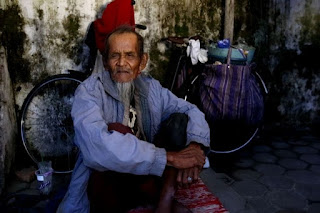
                     He was no longer young. But this 100 year old grandfather has an amazing ability. Yes, Mbah Ujang can speak many languages, ranging from Javanese, Bahasa Medan, English, Japanese, to Dutch.


"I know speak English? I know, speak in Indonesia, Okay," said Mbah Ujang. Mbah Ujang tells when he stepped 28 years, he was brought by the Japanese. There, he worked as a cook and car guard.

Mbah Ujang who came from Brebes, Central Java, this day-to-day work as a scavenger. Since 1971, he spent his life on the roadside around Yogyakarta. Occasionally he stopped at his friend's house. For him, sustenance is already there is a set. Mbah Ujang is never afraid of not being able to eat. "There is only the love of cardboard, plastic, bucket broken, to be patient and nerimo," said Mbah Ujang.


Many people claim that the older the more experience a person has. In addition to experience, should the ability of a person is also more qualified with age is not it?


To some extent, this previously proposed theory fits the figure of Mbah Ujang. A scavenger grandfather found in this area of ​​Yogyakarta has good foreign language skills. Even this century-old man can master at least 5 languages ​​namely English, Japanese, Dutch, Javanese, Minang, Palembang, and of course the Indonesian language.  When asked where his language skills were obtained, Mbah Ujang explained his life story in the colonial era. "When I was 28 years old, I was taken by a Japanese wanderer, so the cook, the car duty, the washerman. Indeed, the man who is now leaving his family in Jakarta and vandalized in Yogyakarta feels very true about the Dutch colonial era and Japanese occupation. But Mbah Ujang did not despair or consider it a bad experience. Precisely it is exploited to develop the ability komunikasinya.


"The language is easy, if heard many times later also understand the meaning," explained the man who sometimes stop at his friend's house. For everyday life, Mbah Ujang work as a scavenger and not too tied to the material that became the priority of most people.


                    Ujang Grand father  is one of the witnesses of colonial colonial history in Indonesia. Although he was a very old age, but his body still looks fit. Grandpa who daily fulfilled the life of scooping used goods is remembered well when Japan came to Indonesia he was young. Now, about the age of Mbah Ujang has reached a century. At that time, the man born in Brebes, Central Java was brought Japan to the city of Medan to work there. He claimed to be forced to work as a cook. After the Japanese occupation, Mbah Ujang moved to various regions. Frequent interaction with many people makes Mbah Ujang able to speak various languages. He speaks fluent Java, Palembang, Minang, English, to Japanese. Until now, he spent his old age in the city of Yogyakarta.

Wednesday, 9 November 2016

GUS DUR STORY

GUS DUR STORY

gus dur


                  The first time he studied, Abdurrahman studied his grandfather, K.H. Hasyim Ash'ari. While at home with his grandfather, he was taught to recite and read the Qur'an. At the age of five he had read al-Qur'an fluently. By the time the father moved to Jakarta, in addition to formal study at school, Gus Dur entered also took private lessons in Dutch. His tutor was Willem Buhl, a German who converted to Islam, who changed his name to Iskandar. To add to the Dutch language lessons, Buhl always presents classical music commonly enjoyed by adults. This is the first time Gu Dur's contact with the West and from here also Gus Dur began to attract and love classical music.


                   Ahead of his graduation at Elementary School, Gus Dur won a writing contest (author) throughout the city of Jakarta and received a gift from the government. This experience explains that Gus Dur has been able to put his ideas / ideas into writing. Therefore it is only natural that in the later period Gus Dur's writings adorn various mass media. After graduating from elementary school, Gus Dur sent his parents to study in Yogyakarta. In 1953 he entered SMEP (Secondary School Economy First) Gowongan, while lodge at Krapyak pesantren. This school, although run by the Roman Catholic Church, but fully uses the secular curriculum. In this school also the first time Gus Dur learn English. Feeling constrained to live in the pesantren world, he finally asked to move to the city and stayed at the home of Haji Junaidi, a local Muhammadiyah leader and an influential person in SMEP. His routine activities, after the dawn prayer recite on K.H. Ma'sum Krapyak, during school day at SMEP, and at night he participated in discussion together with Haji Junaidi and other Muhammadiyah members.

                           As a junior high school student, hobbies to read more getting a place. Gus Dur, for example, was encouraged by his teacher to master English, so within a year or two Abdurrahman spent several books in English. Among the books he had read were Ernest Hemingway, John Steinbach, and William Faulkner. In addition, he also read through the works of Johan Huizinga, Andre Malraux, Ortega Y. Gasset, and several works of Russian writers, such as: Pushkin, Tolstoy, Dostoevsky and Mikhail Sholokov. Gus Dur also devoured some of Wiill Durant's work entitled 'The Story of Civilazation'. In addition to studying by reading English books, in order to improve his English proficiency as well as to explore information, Gus Dur actively listened to the broadcast via Voice of America radio and BBC London. When he learned that Gus Dur was good at Inggis, Mr. Sumatri-a SMEP teacher who was also a member of the Communist Party-gave Lenin's book 'What is To Be Done'. At the same time, the child entering this adolescence has known Karl Marx's Capital Das, Plato's philosophy, Thales, and so on. From this description is clearly illustrated the wealth of information and breadth of Gus Dur's insight. After graduating from SMEP Gus Dur continued his study at Pesantren Tegarejo Magelang Central Java. This pesantren is taken care of by K.H. Chudhari, the humanist, pious and beloved kyai figure. It was Kyai Chudhari who introduced Gus Dur with Sufi rites and inculcated mystical ritual practices. Under the guidance of this kyai, Gus Dur began to make pilgrimages to the sacred tombs of the wali in Java. At the time of admission to this pesantren, Gus Dur brought his entire collection of books, which made the other santri astonished. At this time also Gus Dur has been able to demonstrate his ability in the tumor and speech. In connection with the latter there is an interesting story that should be expressed in this exposure is on ceremonial events held before the fasting at the time of separation of students who finish finished studying-by providing food and drink and bring all the entertainment of the people, such as: Gamelan , traditional dance, lumping horse, jathilan, and so on. Obviously, the entertainment as mentioned above is very taboo for the world of boarding schools in general. However it exists and occurs in Pesantren Tegalrejo.

READ ALSO : BJ HABIBIE
                          INFO BEASISWA


After spending two years at Tegalrejo pesantren, Gus Dur moved back to Jombang, and stayed at Pesantren Tambak Rice. At that time he was approaching 20 years, so in his uncle's pesantren, K.H. Abdul Fatah, he became an ustadz, and became chairman of the security. At the age of 22, Abdurrahman went to the holy land, to perform the pilgrimage, which was then forwarded to Egypt to continue his studies at al-Azhar University. The first time he arrived in Egypt, he was disappointed because he could not directly enter al-Azhar University, but had to enter Aliyah (a kind of preparatory school). At school he was bored, having to repeat the subjects he had taken in Indonesia. To eliminate boredom, Abdurrahman often visited the American library and information service center (USIS) and bookstores where he could get the books he wanted.


                      There was a favorable condition when Abdurrahman was in Egypt, under the rule of President Gamal Abdul Nasr, a dynamic nasioonalis, Cairo became the golden age of intellectuals. The freedom to express opinions has sufficient protection. In 1966 Abdurrahman moved to Iraq, a modern state with an advanced Islamic civilization. In Iraq he entered the Department of Religion at Baghdad University until 1970. During his stay in Baghdad Abdurrahman had a different life experience than in Egypt. In this thousand-night city Abdurrahman got intellectual stimulation not found in Egypt. At the same time he came back in touch with the great books of Western orientalist scholars. He went back to his hobby intensively by reading almost all the books in the University. Outside the world of the campus, Gus Dur diligently visits the sacred tombs of the saints, including the tomb of Sheikh Abdul Qadir al-Jailani, founder of the Qadiriyah congregation. He also writes the teachings of Imam Junaid al-Baghdadi, a founder of Sufism, followed by NU worshipers. This is where Gus Dur finds the source of his spirituality. The political situation that happened in Iraq influenced the development of Gus Dur's political thinking at the time. His admiration for the power of Arab nationalism, especially to Saddam Husain as one of his characters, became diminished when the shaykh he knew, Azis Badri was killed.  After studying in Baghdad Gus Dur intends to continue his studies to Europe. But strict requirements, especially in the language-for example, to enter in the classical study in Kohln, have to master the Hebrew, Greek or Latin languages ​​well in addition to the German language-it can not be fulfilled, the last thing to do is make a visit and become a traveling student, from one university to another. He eventually settled in the Netherlands for six months and founded the Muslim Students Association of Indonesia and Malaysia who live in Europe. For living expenses, he goes to the port twice a month to work as a tanker cleaner. Gus Dur also went to McGill University in Canada to study Islamic studies in depth. However, he finally returned to Indonesia after being inspired by interesting news about the development of the pesantren world. The tour of Gus Dur's study ended in 1971, when he returned to Java and began to enter his new life, as well as his early career journey.


                        Nevertheless, the spirit of learning Gus Dur did not recede. The proof in 1979 Gus Dur was offered to study at a university in Australia to obtain a doctorate. But the good intentions can not be fulfilled, because all the promoters are incapable, and assume that Gus Dur does not need the title. Indeed, in fact some doctoral dissertations from Australia were sent to Gus Dur for correction, guided, and then maintained in front of an academic session.


FULL NAME
KH. Abdurrahman Wahid
DATE OF BIRTH
Jombang, August 04, 1940
FATHER
KH. A. Wahid Hasyim
MOTHER
Ny. Hj. Sholehah
WIFE
Sinta Nuriyah
CHILD
Alissa Qotrunnada
Zannuba Ariffah Chafsoh
Anita Hayatunnufus
Inayah Wulandari
EDUCATION
1966-1970
University of Baghdad, Iraq, Faculty of Adab Department of Arabic Literature
1964-1966
Al Azhar University, Cairo, Egypt, Faculty of Shari'ah (Kulliyah al-Syari'ah)
1959-1963
Pesantren Tambak Beras, Jombang, East Java, Indonesia
1957-1959
Pesantren Tegalrejo, Magelang, Central Java, Indonesia
EXPERIENCE OF POSITION
1999-2001
President of the Republic of Indonesia
1989-1993
Member of the People's Consultative Assembly of the Republic of Indonesia
1987-1992
Chairman of the Indonesian Ulema Council
1984-2000
Chairman of the Board of PBNU Tanfidz